
Teaching Parents More Than What to Do: Integrating ACT Into Evidence-Based Youth Anxiety Treatment
"My anxious child is the one who needs help, so why are we talking about me?"
It's a question we hear often when introducing caregivers of youth with anxiety disorders and OCD to parent-focused ACT (Raftery-Helmer et al., 2024, 2026). For clinicians already fluent in the model, the more interesting question isn't whether ACT applies to parents. Of course it does! Parents have minds too, after all. It's where in the hexaflex accommodation actually lives, and what that implies for how we intervene. Spoiler alert: It’s rooted in every part of the hexaflex.
Accommodation as Topography, Not Function
If you know even a little about treating pediatric anxiety, it’s probably this: CBT for pediatric anxiety and OCD remains the gold-standard. Yet up to 40% of youth retain clinically significant symptoms after a high-quality course (Ginsburg et al., 2011). Parental accommodation (reassurance-giving, facilitated avoidance, routine modification) is a well-replicated maintaining variable (e.g., Kagan et al., 2016), so it's a natural and modifiable intervention target (Sperling et al., 2025). The problem is that most parent-training add-ons treat accommodation as the target behavior itself, and psychoeducation plus behavioral instruction to reduce it hasn't reliably moved outcomes when bolted onto child-focused CBT (Manassis et al., 2014; Peris et al., 2021).
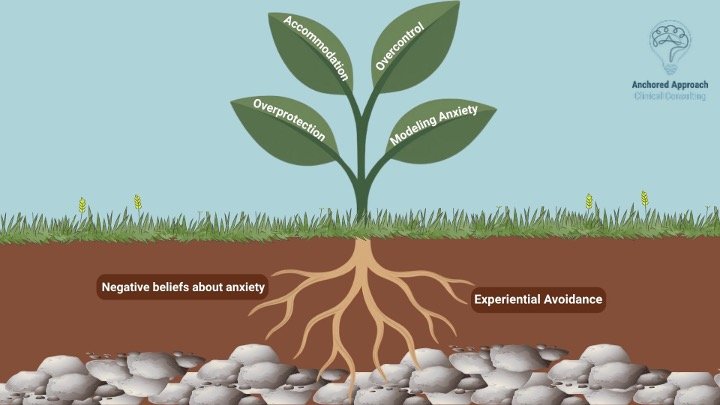
From a functional-contextual standpoint, this isn't surprising. Accommodation is topography. The same overt behavior can be maintained by wildly different contingencies across parents, and often across moments within the same parent. Telling a parent to accommodate less is an instruction aimed at topography while the influential variables sit below the surface:
fusion with thought content such as, “A good parent doesn’t let their child worry,”
rigid self-rules about what "good parenting" requires, and
experiential avoidance fueled by the cycle of a parent's own aversive emotions retreating when the child's distress resolves.
Reducing the behavior without addressing its function is akin to pulling the leaves off a weed while leaving the root – it's likely to grow back and may even pop up elsewhere.
The Coupled System
Accommodation doesn't happen in the parent's world alone; it's embedded in a bidirectional loop. Parents higher in experiential avoidance and cognitive fusion report more distress and accommodate more (Baarden & Fergus, 2016; Emerson et al., 2019; Feinberg et al., 2018). Parental internalizing symptoms predict child anxiety trajectories, and child anxiety predicts increases in parental depression over time (Johnco et al., 2021). The causal arrows run in both directions, which is what you'd expect if you consider that parents function as discriminative and dynamic stimuli embedded in the child's environment, not as bystanders to it.
The data on parent modeling make the mechanism concrete: children who observe a parent respond anxiously to an ambiguous stressor subsequently report more anxiety than children who observe a parent responding calmly, an effect that holds even without any verbal instruction (Burnstein et al., 2010). Children are tracking the parent's relationship to uncertainty, not just the parent's words about it. This reframes the clinical target: Instead of exclusively examining whether the parent believes the child will be okay and how the parent is communicating this explicitly to the child, the focus widens to include what stance toward uncertainty the parent is modeling in vivo, moment to moment.
What ACT Is Actually Targeting
None of this is about symptom reduction for the parent, which is worth stating plainly for any co-treating clinician who might otherwise expect an outcome focused on it. The target is psychological flexibility: contact with the present moment, cognitive defusion from unhelpful/inaccurate thoughts about their child’s anxiety or their own response to it, and values-consistent committed action, held concurrently with unresolved uncertainty about the child's outcome.
The clinical move isn't cognitive restructuring of my child will be okay. It's closer to:
Can you notice your mind delivering the idea that "they won't be okay," hold that thought as a thought, and still stand behind the exposure because standing behind it is what the parent you want to be does here?
Can you show your child that approach behaviors are valued more than controlling anxiety?
That's willingness in service of values, not distress tolerance for its own sake. If a parent leaves a session feeling calmer but no more willing to experience their own emotions when their child struggles without rescuing either of them, that's not a flexibility gain. It's more of the same control agenda by a different name, and worth flagging as a workability check on the session itself.
Where the Evidence Sits
Parent-focused ACT interventions have an established empirical base across autism, ADHD, chronic illness, and elevated parenting stress more broadly, with recent systematic reviews showing gains in parental psychological flexibility and reductions in parenting stress across these populations (e.g., Li et al., 2023; Byrne et al., 2021). Scientific studies evaluating ACT tailored to parents of youth with anxiety disorders have emerged more recently.
In our six-week pilot ACT group for caregivers of anxious youth (Raftery-Helmer et al., 2024), parents showed reductions in cognitive fusion and rated the intervention highly acceptable. Qualitative data (Raftery-Helmer et al., 2026) revealed that parents found the experiential practices helpful and also difficult to maintain outside of the group sessions, particularly mindfulness and other present-moment awareness exercises. Parents asked for more accountability for this practice, suggesting that parents see the benefit of experiential learning to foster psychological flexibility in relation to their child’s anxiety symptoms.
A Live Tension Worth Naming
This isn't a case for ACT instead of accommodation-specific protocols like SPACE (Lebowitz et al., 2014, 2020). The two interventions don’t have to be in competition with one another, but rather can be complementary. SPACE targets accommodation directly via structured behavioral commitments and supportive statements, largely bypassing parental internal experience as a treatment target. An ACT approach posits that behavior change is more durable when the parent's relationship to the private events driving accommodation shifts first, or at least concurrently. Whether or not psychological flexibility-focused work outperforms direct accommodation-reduction protocols, or perhaps achieves the same behavioral endpoint through a different route, is worthwhile empirical question. The equally important questions lie in the who, how and why: for which parents, which accommodation profiles, what kind of symptom severity, etc. do these interventions each best apply? Clinical Application Without Discarding What Works
Clinical Application Without Discarding What Works
You don't need to replace CBT or stop addressing accommodation directly. The addition of ACT for parents of anxious youth is a functional assessment question layered onto the existing protocol whenever parent behavior seems stuck:
What private event is this behavior aimed at avoiding, and what would committed action look like if the parent held that content lightly instead of tightly?
Sometimes a brief cognitive defusion exercise ahead of an accommodation conversation changes what's available in the room. Sometimes anchoring the parent to their own values (the parent they want to be, not the parent who eliminates all suffering) produces more movement than another pass through the anxiety-maintenance cycle. And sometimes the accommodation is genuinely secondary to the parent avoiding their own arousal, in which case the primary or sole intervention target may not be child's exposure hierarchy; the parent can be invited to practice willingness to experience the uncomfortable physical sensations in the service of supporting and modeling this for their child.
You don't need to replace CBT or stop addressing accommodation directly. The addition of ACT for parents of anxious youth is a functional assessment question layered onto the existing protocol whenever parent behavior seems stuck:
What private event is this behavior aimed at avoiding, and what would committed action look like if the parent held that content lightly instead of tightly?
Sometimes a brief cognitive defusion exercise ahead of an accommodation conversation changes what's available in the room. Sometimes anchoring the parent to their own values (the parent they want to be, not the parent who eliminates all suffering) produces more movement than another pass through the anxiety-maintenance cycle. And sometimes the accommodation is genuinely secondary to the parent avoiding their own arousal, in which case the primary or sole intervention target may not be child's exposure hierarchy; the parent can be invited to practice willingness to experience the uncomfortable physical sensations in the service of supporting and modeling this for their child.
The Reframe
Parents aren't solely exposure coaches to be trained on protocol adherence. They're part of the contingency arrangement the child is learning within, and they're managing their own aversive private events while trying to change their behavior to help their child. Targeting parental psychological flexibility in tandem with accommodation reduction opens intervention points that behavior-only protocols can't reach on their own.
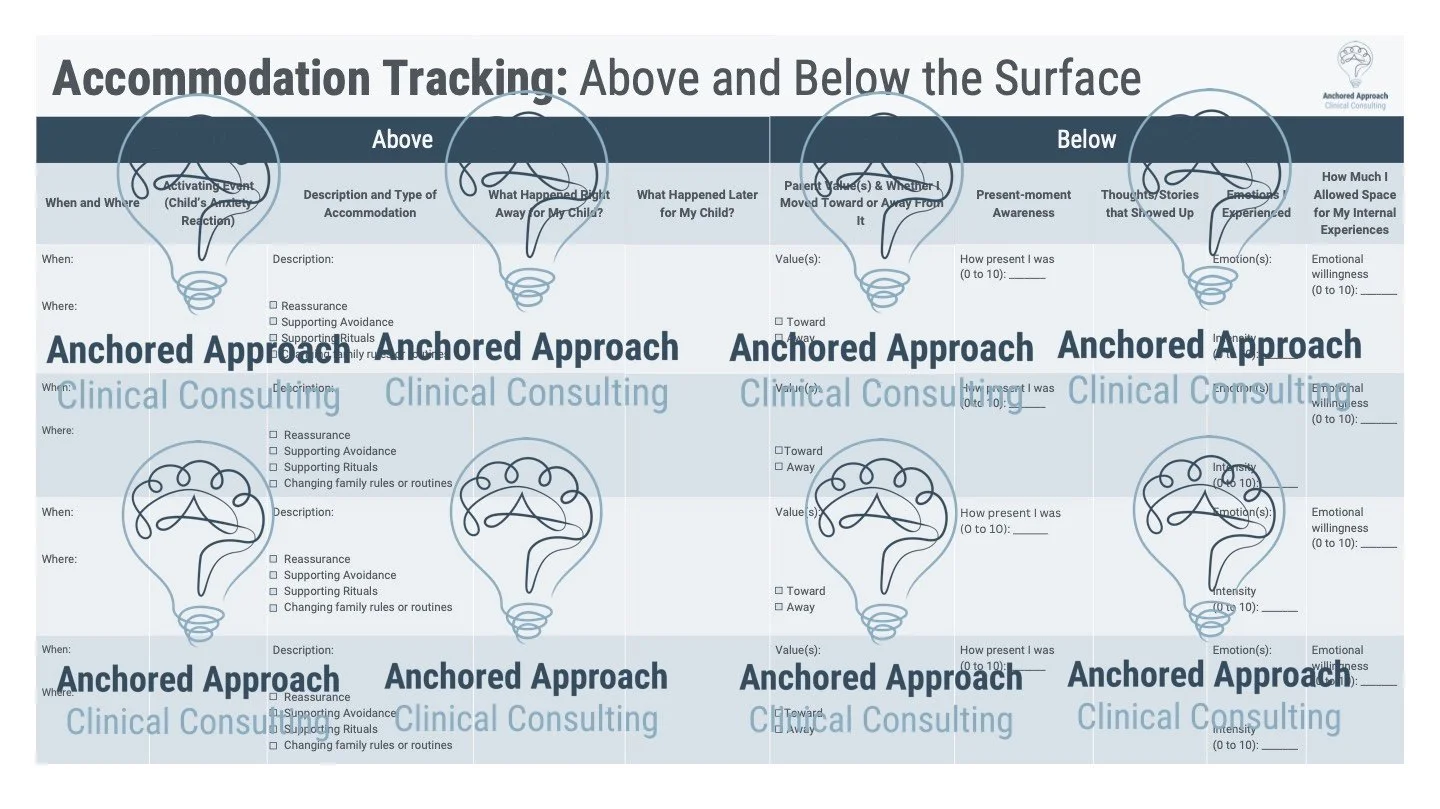
Help parents understand not just what accommodation occurred, but what made it so difficult not to accommodate.
Family accommodation is one of the most important maintaining factors in pediatric OCD and anxiety and one of the hardest patterns for parents to change. This ACT-informed worksheet helps clinicians move beyond simply identifying accommodation by guiding parents to explore the thoughts, emotions, present-moment awareness, willingness, and values that influenced their response.
Rather than only addressing accommodation as a behavior to eliminate, this worksheet helps families understand the psychological processes that keep accommodation going. By examining what happened above the surface (the accommodation itself) and below the surface (the parent's internal experience), clinicians can facilitate richer discussions, strengthen case conceptualization, and help parents make more flexible, values-guided choices.
Use this worksheet to deepen parent coaching, reinforce ACT-consistent principles alongside ERP, and generate meaningful between-session learning.
Help parents:
Recognize patterns of family accommodation
Identify the thoughts and emotions that influence accommodation
Increase present-moment awareness during challenging interactions
Connect parenting decisions to their values
Build greater psychological flexibility when responding to child anxiety and OCD
Reflect on patterns between sessions to support lasting behavior change
Best for:
Parent coaching
Between-session homework
What's included: A clean, professionally designed one-page fillable worksheet, ready to print or use digitally with clients.
Clinicians can be asking parents, What would it look like for you to stay in contact with your values when your mind is telling you not to, and when uncomfortable feelings show up alongside this? Parenting sessions can focus on what lies beneath the surface of behaviors to help break a cycle of unworkable strategies inadvertently fueling both parent and child anxiety. Researchers can look to whether building that capacity changes outcomes for parent and child alongside direct accommodation-reduction work. That's an empirical question the field can begin to answer.
Ready to learn more about integrating ACT into your work with parental accommodation behaviors?
References
Bardeen, J. R., & Fergus, T. A. (2016). The interactive effect of cognitive fusion and experiential avoidance on anxiety, depression, stress, and posttraumatic stress symptoms. Journal of Contextual Behavioral Science, 5(1), 1–6. https://doi.org/10.1016/j.jcbs.2016.02.002
Burstein, M., & Ginsburg, G. S. (2010). The effect of parental modeling of anxious behaviors and cognitions in school-aged children: An experimental pilot study. Behaviour Research and Therapy, 48(6), 506–515. https://doi.org/10.1016/j.brat.2010.02.006
Byrne, G., Ní Ghráda, A., O’Mahony, T., & Brennan, E. (2021). A systematic review of the use of acceptance and commitment therapy in supporting parents. Psychology and Psychotherapy: Theory, Research and Practice, 94(Suppl. 2), 378–407. https://doi.org/10.1111/papt.12282
Emerson, L. M., Aktar, E., de Bruin, E., Potharst, E., & Bögels, S. M. (2021). Mindful parenting in secondary child mental health: Key parenting predictors of treatment effects. Mindfulness, 12(2), 532–542. https://doi.org/10.1007/s12671-019-01176-w
Feinberg, L., Kerns, L., Pincus, D. B., & Comer, J. S. (2018). A preliminary examination of the link between maternal experiential avoidance and parental accommodation in anxious and non-anxious children. Child Psychiatry & Human Development, 49(4), 652–658. https://doi.org/10.1007/s10578-018-0781-0
Ginsburg, G. S., Kendall, P. C., Sakolsky, D., Compton, S. N., Piacentini, J., Albano, A. M., Sherrill, J., Walkup, J. T., Coffey, K. A., Rynn, M. A., Keeton, C. P., Birmaher, B., March, J. S., McCracken, J. T., Iyengar, S., & Sullivan, K. (2011). Remission after acute treatment in children and adolescents with anxiety disorders: Findings from the CAMS. Journal of Consulting and Clinical Psychology, 79(6), 806–813. https://doi.org/10.1037/a0025933
Kagan, E.R., Peterman, J.S., Carper, M.M. and Kendall, P.C. (2016), Accommodation and Treatment of Anxious Youth. Depression and Anxiety, 33: 840-847. https://doi.org/10.1002/da.22520
Johnco, C. J., Magson, N. R., Fardouly, J., Oar, E. L., Forbes, M. K., & Rapee, R. M. (2021). The role of parenting behaviors in the bidirectional and intergenerational transmission of depression and anxiety between parents and early adolescent youth. Depression and Anxiety, 38(12), 1256–1266. https://doi.org/10.1002/da.23197
Li, S., Chen, Z., Yong, Y., Xie, J., & Li, Y. (2023). Effectiveness of acceptance and commitment therapy-based interventions for improving the psychological health of parents of children with special health care needs: A systematic review and meta-analysis. Comprehensive Psychiatry, 127, 152426. https://doi.org/10.1016/j.comppsych.2023.152426
Manassis, K., Lee, T. C., Bennett, K., Zhao, X. Y., Mendlowitz, S., Duda, S., Saini, M., Wilansky, P., Baer, S., Barrett, P., Bodden, D., Cobham, V. E., Dadds, M. R., Flannery-Schroeder, E., Ginsburg, G., Heyne, D., Hudson, J. L., Kendall, P. C., Liber, J., ... Wood, J. J. (2014). Types of parental involvement in CBT with anxious youth: A preliminary meta-analysis. Journal of Consulting and Clinical Psychology, 82(6), 1163–1172. https://doi.org/10.1037/a0036969
Peris, T. S., Thamrin, H., & Rozenman, M. S. (2021). Family intervention for child and adolescent anxiety: A meta-analytic review of therapy targets, techniques, and outcomes. Journal of Affective Disorders, 286, 282–295. https://doi.org/10.1016/j.jad.2021.02.053
Raftery-Helmer, J. N., Hart, A. S., Levitt, M. R., Hodge, S. M., Coyne, L. W., & Moore, P. S. (2024). Acceptance and commitment therapy group protocol for caregivers of anxious youth: An open trial pilot study. Frontiers in Child and Adolescent Psychiatry, 3, 1347295. https://doi.org/10.3389/frcha.2024.1347295
Raftery-Helmer, J. N., Hart, A. S., Faro, A. L., Baez, D., & Moore, P. S. (2026). A qualitative study of participant feedback on an acceptance and commitment therapy group-based intervention for parents of youth with anxiety disorders. Children, 13(6), 837. https://doi.org/10.3390/children13060837
Sperling, J. B., Stark, A. M., Woodson, O., Tung, E. S., Falkenstein, M. J., & Kuckertz, J. M. (2025). Family Accommodation of OCD and Anxiety Symptoms Across the Lifespan. The Behavior therapist, 48(6), 676–694.