
Why Clear Psychoeducation Is an Underrated Skill in ERP
Exposure and Response Prevention is the gold-standard psychotherapy treatment for Obsessive-Compulsive Disorder, as it is supported by very strong scientific evidence.
Not every client is fully helped by or fully benefits from ERP. This can be for many different reasons. One common reason is that clients don’t fully understand what they’re doing and why.
The gap between clients knowing what to do and why they do it in ERP can be filled by clear, tailored, and ongoing psychoeducation.
Why ERP Often Breaks Down
If you’ve started doing ERP as a newer clinician, you’ve probably seen this:
An adult client agrees to exposures… but avoids them between sessions
A child “does the exposure”… but sneaks in subtle rituals
A teen says, “This isn’t working, I still feel anxious”
A parent steps in to reduce their child’s distress mid-exposure
This doesn’t necessarily reflect resistance or low motivation. Instead, it can reflect a misunderstanding of how ERP works and what it is trying to accomplish.
ERP is not intuitive. It asks clients to move toward discomfort while resisting the behaviors that usually reduce it. Clients need to understand why they are choosing anxiety and uncertainty on purpose.
Many clients enter treatment assuming:
“Therapy should help me feel better quickly.”
“If I’m still anxious, something isn’t working.”
“Exposure means facing fears, but I can still cope in my usual ways.”
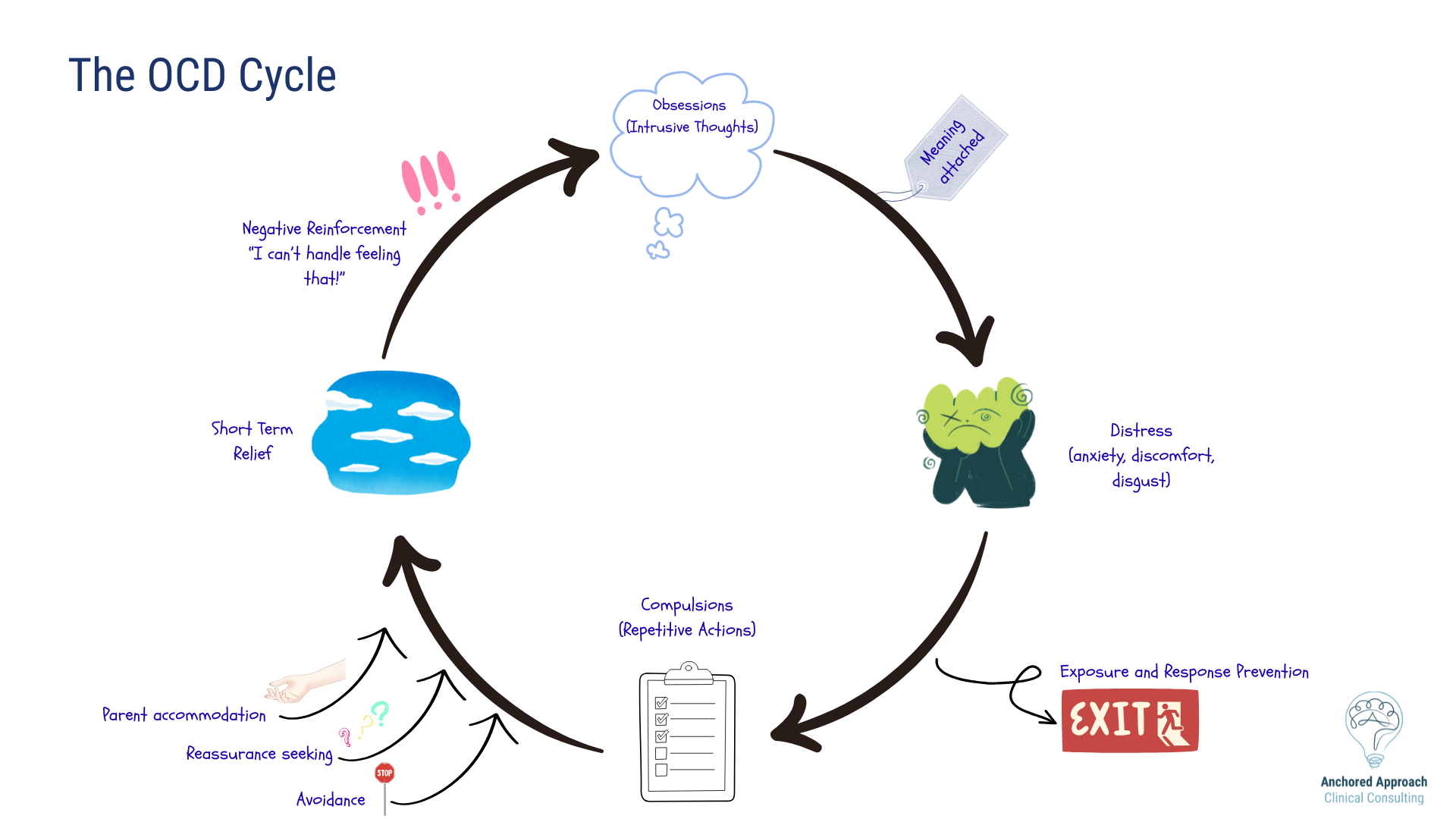
But ERP works by interrupting the obsession–compulsion cycle. Compulsions create short-term relief while reinforcing long-term OCD symptoms. ERP teaches clients to approach discomfort without escaping it through rituals or avoidance behaviors.
If the OCD cycle, and how ERP interrupts it, is not clear to the client, the foundation for treatment becomes shaky.
Psychoeducation Isn’t a Warm-Up — It’s a Critical Part of the Intervention
All types of cognitive-behavioral therapy protocols models include psychoeducation as a core component of therapy, not an optional warm-up. This is true for ERP.
Effective psychoeducation does three things:
Builds buy-in (“This makes sense”)
Sets expectations (“This will be challenging, and that’s the point”)
Targets mechanisms (“Compulsions are the problem, not the obsession”)
When those pieces are clear, clients move more fluidly into engaging in ERP.
A Common ERP Mistake: Underemphasizing Response Prevention
When explaining ERP, newer clinicians tend to give more weight to exposure and to gloss over or leave out response prevention.
But ERP is not just:
“Face your fears.”
It’s:
“Face your fears and don’t do what OCD tells you to do to feel less scared or uncomfortable.”
ERP works because it interrupts the negative reinforcement loop between obsessions and compulsions.
If response prevention is inconsistently implemented:
exposures don’t fully allow for new learning
subtle rituals continue to maintain the OCD cycle
clients are less likely to see meaningful progress
This is especially important when addressing mental rituals, reassurance seeking, avoidance, or other compulsions that are not visible or obvious.
The Complete ERP Toolkit
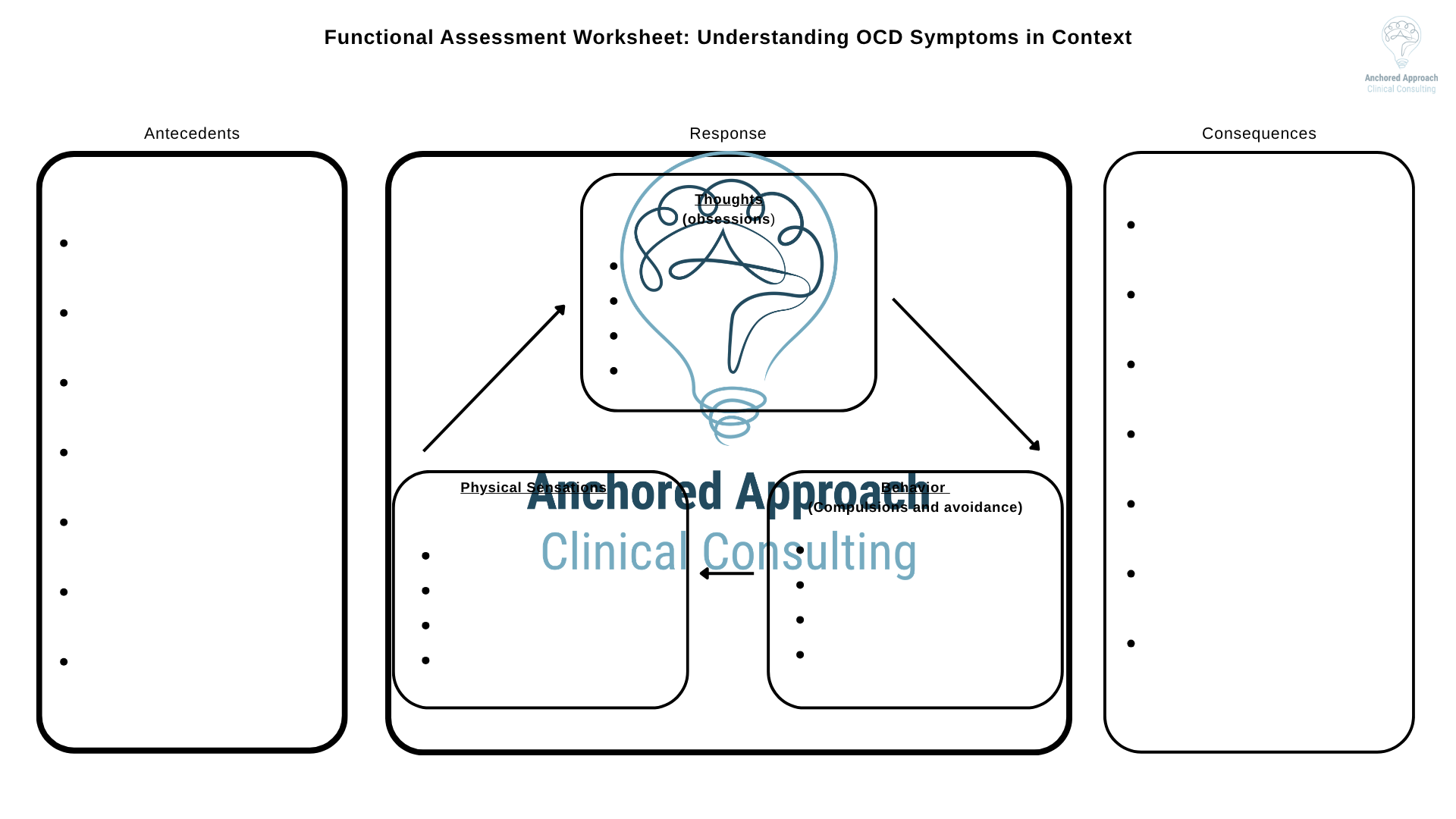
A practical set of ACT-informed ERP tools designed to help clinicians move from conceptualization to exposure planning, practice, and review with children, adolescents and adults.
No more piecing together worksheets or creating your own ERP forms. Use these ready-to-go tools to structure exposures in session and between sessions.
With The Complete ERP Toolkit, you can:
Map the OCD cycle
Functional Analysis WorksheetPlan the exposure
Brave Move At-Home Forms (Kid and Adolescent Versions)Toward Move In-Session Planner
Put exposures into action
Brave Move In-Session Forms (Kid and Adolescent Versions)Toward Move At-Home Planner
Review and adjust
Brave Move Review Forms (Kid and Adolescent Versions)
Toward Move Review Forms
13 ready-to-use clinical tools for ERP clients of all ages.
Why This Matters Even More with Kids
Kids are more likely to:
interpret instructions literally
focus on immediate outcomes (“Did I feel better?”)
miss the abstract goal of “learning over instant relief”
If psychoeducation skims the surface, ERP can feel like punishment or forced discomfort to a young client.
That’s why developmentally appropriate language matters, such as:
“Be a brave explorer”
“Make a brave move”
“Break OCD’s rules”
Creative metaphors help translate complex behavioral principles into something kids can actually use.
How to Check Whether Clients Actually Understand ERP
Before starting ERP, ask yourself:
Does this client fully understand what we’re doing and why?
1. Have Them Explain the Model Back to You
Ask:
“What is OCD trying to get you to do?”
“What are we going to do differently and why?”
If they can’t explain why approaching discomfort instead of escaping it is the goal, they’re probably not ready for ERP yet.
2. Test Both Parts of ERP Explicitly
Ask:
“What’s the ‘face your fears’ part?”
“What’s the ‘not doing what OCD says’ part?”
Suggest both overt and subtle rituals and see if kids can recognize each one as ways that OCD tries to gain control back after an exposure.
If response prevention isn’t clear, it’s unlikely to happen consistently.
How to Define Success in ERP
Many clients mistakenly believe:
“When I feel less anxious, I’ll know it’s working.”
But modern ERP models increasingly emphasize inhibitory learning rather than anxiety reduction as a targeted outcome of ERP trials. The goal is not to reduce or eliminate distress in relation to obsessions, but to build new learning that anxiety, uncertainty, and discomfort can be tolerated without compulsions.
Inhibitory learning models suggest that a more optimal marker of progress is willingness rather than short-term anxiety reduction. This approach also aligns closely with ACT-informed ERP models that focus on willingness, flexibility, and learning rather than symptom reduction.
Becoming a More Effective ERP Clinician
Most ERP trainings teach:
what ERP is
how to build hierarchies
how to run exposures
But they spend less time on:
ensuring patients truly understand the model
detecting subtle response prevention failures
adapting ERP for kids and families
maintaining treatment fidelity when sessions get messy
how to move flexibly between different aspects of treatment (things are never as linear as the manual)
That’s often where consultation becomes invaluable.
If you’re working with clients with OCD or anxiety disorders and want to feel more confident delivering ERP in real clinical situations, check out some of our offerings:
The Bottom Line
ERP is not just exposure to fear.
It’s learning that discomfort can be carried without obeying OCD.
Clear psychoeducation is what transforms ERP from a set of techniques into a meaningful mechanism of change.
-
Psychoeducation in Exposure and Response Prevention (ERP) therapy involves helping clients understand the OCD cycle, how compulsions reinforce anxiety, and why ERP requires approaching discomfort without engaging in rituals or reassurance behaviors. It involves an ongoing practice of developing, checking in with and enhancing a client’s understanding of the what, why, and how of ERP.
-
Psychoeducation helps clients understand why ERP feels difficult and why resisting compulsions is essential for treatment success. Clear psychoeducation improves buy-in, sets realistic expectations, and helps clients engage more effectively in ERP.
-
Without response prevention, clients may continue engaging in compulsions that maintain the OCD cycle. ERP is most effective when clients both approach feared situations and resist rituals, including mental compulsions, and avoidance behaviors.
-
ERP for children often works best when therapists use developmentally appropriate language and metaphors such as “breaking OCD’s rules” or “making brave moves.” Psychoeducation should help children understand that the goal of ERP is learning to manage discomfort rather than getting rid of anxiety.
-
Inhibitory learning is a modern model of ERP that focuses on helping clients build new learning about anxiety, uncertainty, and discomfort. Rather than aiming for anxiety reduction, ERP helps clients learn what happens when they resist engaging in compulsions and do not try to eliminate obsessions, especially that they can tolerate distress without relying on rituals to relieve it.